
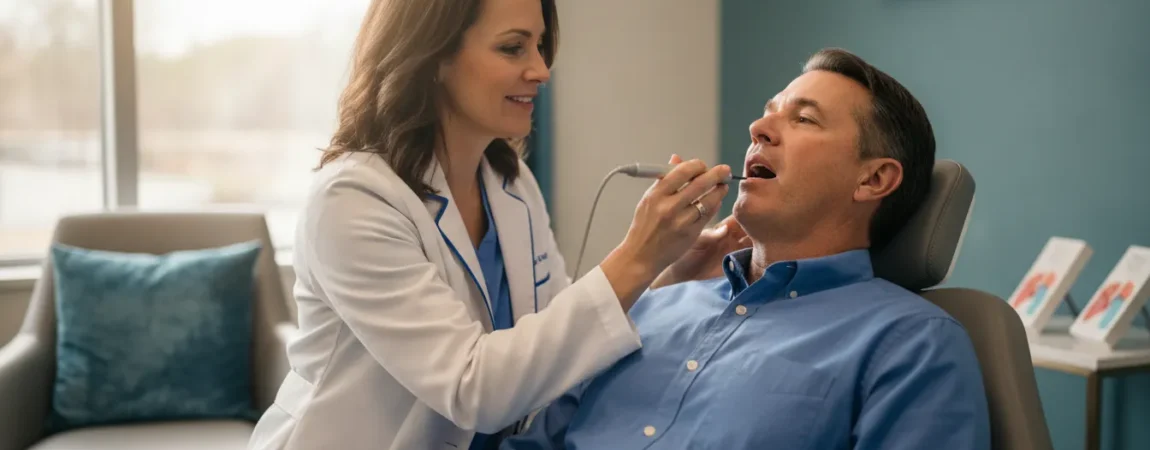
Airway anatomy can influence how obstructive sleep apnea is evaluated and treated, but understanding that anatomy requires more than looking at symptoms alone. Eccovision gives clinicians a noninvasive way to examine the shape and size of the upper airway as part of a broader assessment.
Eccovision pharyngometry airway assessment sleep apnea uses sound waves to measure upper-airway cross-sectional area in real time. It can help identify potential areas of narrowing and inform individualized oral appliance planning, but it does not diagnose sleep apnea or replace a physician-led sleep study.
A complete evaluation also considers your medical history, sleep-study results, oral and airway health, and temporomandibular joint function. Learning how the Eccovision pharyngometer works is the first step toward understanding what this focused airway assessment can, and cannot, reveal.
What Is an Eccovision Pharyngometer?
An Eccovision pharyngometer is an airway assessment system that uses sound waves to collect information about the upper airway. Spark Sleep Solution describes the technology as acoustic pharyngometry and rhinometry. In practical terms, it provides real-time measurements that help show the size and structure of portions of the oral, pharyngeal, and nasal airway.
What do acoustic pharyngometry and rhinometry measure?
Acoustic pharyngometry is a noninvasive method for assessing the cross-sectional area of the upper airway. The system sends sound into the airway and analyzes the reflected signal to estimate how the airway changes along its length. Spark describes Eccovision pharyngometry as measuring pharyngeal airway size and stability from the oropharyngeal junction toward the glottis.
Acoustic rhinometry applies the same general sound-reflection concept to the nasal airway. Together, pharyngometry and rhinometry can give a clinician additional anatomical information during an in-office airway evaluation. The findings may help identify areas that warrant closer attention and contribute to individualized treatment planning.
Is Eccovision a sleep apnea diagnostic test?
No. An Eccovision assessment does not diagnose obstructive sleep apnea by itself. Sleep apnea diagnosis is physician-led and depends on the appropriate clinical evaluation and sleep testing. One adult study of acoustic pharyngometry examined airway cross-sectional-area measurements in patients with suspected obstructive sleep apnea who also underwent polysomnography. That study design illustrates the distinction: airway measurements were evaluated alongside a sleep study, not used as a replacement for one. Read the study details on PubMed.
For that reason, pharyngometry should be understood as an adjunct to comprehensive care. It can add anatomical context to an evaluation, while a sleep physician determines whether sleep apnea is present and what diagnosis and treatment plan are appropriate. If you are beginning the process, you can also review what to expect at your first appointment.
After diagnosis, airway measurements may also help a dental sleep medicine clinician assess how mandibular advancement relates to the airway when considering an oral appliance. They inform the conversation, but they do not guarantee a particular treatment response or replace coordinated physician care.
How Does Acoustic Pharyngometry Measure the Airway?
Acoustic pharyngometry uses reflected sound waves to create an estimate of the airway’s shape and size. In practical terms, the test turns information about the upper airway into a visual representation that a clinician can review alongside your symptoms, medical history, and other sleep-related testing. It is an airway assessment, not a diagnosis of obstructive sleep apnea.
- Sound waves are directed toward the upper airway. The Eccovision system uses acoustic energy to assess the passage behind the mouth and throat. As the sound travels through the airway, the pattern of the returning reflections contains information about the airway’s internal dimensions. Acoustic pharyngometry is described in medical research as a noninvasive method for assessing upper-airway cross-sectional area. Read the research on acoustic pharyngometry.
- The reflections are translated into airway measurements. Changes in the reflected signal help estimate cross-sectional area at different points along the measured airway. A clinician can use these measurements to examine the relative size and shape of the pharyngeal airway, rather than relying only on a visual inspection. The assessment may also help identify areas that warrant closer consideration during a broader evaluation.
- The findings are shown as an airway map or graph. Instead of receiving only a single number, you may see a curve or airway map that represents how the estimated airway dimensions change from one region to another. The visual pattern can make potential narrowing or differences between airway regions easier to discuss. It does not show every factor that affects breathing during sleep, and it should not be interpreted as proof that a person does or does not have sleep apnea.
- The results are considered with your complete evaluation. A sleep study and physician-led assessment remain central to sleep apnea diagnosis and testing. Once diagnosis and treatment needs are established, airway measurements can add anatomical context to the conversation about individualized care. In appropriate cases, they may help a dental sleep medicine provider evaluate how the airway relates to oral appliance planning, without promising a particular treatment response.
How Does Eccovision Pharyngometry Support Airway Assessment for Sleep Apnea?
An Eccovision assessment can provide anatomical clues about the upper airway. In particular, acoustic pharyngometry measures the airway’s cross-sectional area, helping show where the passage is relatively narrower or more open during the assessment. These measurements may add useful context when a clinician is evaluating snoring, suspected obstructive sleep apnea, or possible oral appliance therapy.
Research has found an association between smaller airway measurements and obstructive sleep apnea. In one adult clinical cohort, the median sitting upper-airway cross-sectional area was smaller among participants with OSA than among those without it. After adjustment for age, sex, body mass index, and comorbidities, the odds of OSA increased as the mean sitting airway area decreased. These findings suggest that airway anatomy can be relevant to risk assessment, but they do not mean that a smaller measurement confirms OSA or that a larger measurement rules it out. The study’s participants were also people already being evaluated for suspected OSA, so its results should not be applied as a stand-alone prediction for every patient.
Why the measurements are not a diagnosis
The same study found only fair discrimination for OSA, with an area under the curve of 0.60. A selected airway-area cutoff had 73% sensitivity and 46% specificity, which illustrates why a single measurement cannot reliably separate people with and without sleep apnea. Adding airway area to clinical variables produced only a small, statistically nonsignificant improvement in discrimination. The researchers concluded that the measurements offered no significant additional advantage over clinical variables for discerning OSA. You can review the study methods and findings in the published PubMed report.
In practical terms, Eccovision results are best viewed as one piece of a broader evaluation. They may help a dental sleep medicine clinician understand airway anatomy and identify questions for further assessment, but they do not measure nighttime breathing events, oxygen changes, or sleep-stage patterns. A physician-led sleep evaluation and appropriate sleep testing remain necessary for diagnosis. The results should be interpreted alongside your symptoms, medical history, examination findings, and sleep-study results rather than used to label or exclude a condition on their own.
This distinction matters because obstructive sleep apnea is a dynamic disorder. Airway behavior can change with sleep, body position, muscle tone, and other factors that an awake airway assessment cannot fully reproduce. Used appropriately, Eccovision can support informed clinical discussion without replacing the testing and coordinated care required to determine whether treatment is appropriate.
How Does Pharyngometry Guide Oral Appliance Selection?
Airway assessment can add an important anatomical perspective to oral appliance treatment planning. Eccovision pharyngometry measures the shape and cross-sectional area of the upper airway, helping the clinical team consider where narrowing or potential obstruction may occur. That information is reviewed alongside your medical history, sleep-study findings, oral examination, and jaw and temporomandibular joint evaluation. It is not used by itself to prescribe a device or predict exactly how you will respond.
Connecting airway anatomy with mandibular advancement
Many custom oral appliances work by positioning the lower jaw forward during sleep. This mandibular advancement can change the position of tissues around the upper airway. Pharyngometry may help clinicians observe airway changes associated with mandibular advancement after sleep apnea has been diagnosed, giving the treatment team another source of information when discussing appliance design and positioning. The measurement is a planning aid, not a guarantee that a particular advancement setting or appliance will produce a specific result.
In practical terms, the assessment may help identify anatomical considerations that matter when selecting and adjusting a custom device. The goal is an individualized plan that accounts for airway findings, jaw movement, tooth and gum health, comfort, and any TMJ symptoms. A device should fit your clinical circumstances rather than be selected from a one-size-fits-all assumption.
Why the measurement is only one part of the decision
Acoustic pharyngometry is a noninvasive airway measurement technique, but it does not replace physician-led diagnosis or a sleep study. Research has found associations between airway measurements and obstructive sleep apnea, while also showing that these measurements alone have limited ability to distinguish who has the condition. For that reason, an airway result should be interpreted in context and used to support, not replace, comprehensive care.
After diagnosis and prescription, your dentist can use the full evaluation to discuss whether oral appliance therapy is an appropriate treatment option and what type of custom oral device may fit your needs. Follow-up remains essential, because treatment planning is an ongoing clinical process rather than a decision made from one measurement.
Why Is Eccovision Only One Part of a Complete Evaluation?
An Eccovision airway assessment can add useful information about airway structure, but it cannot answer every clinical question involved in sleep apnea care. Acoustic pharyngometry measures upper-airway dimensions noninvasively. Research has examined whether these measurements can help distinguish obstructive sleep apnea, but airway measurements alone have shown only fair ability to discriminate OSA and should not be treated as a diagnosis. Published research on acoustic pharyngometry evaluated the measurements alongside polysomnography, not instead of it.
That distinction matters for your safety. A complete evaluation usually brings together several sources of information:
- Physician-led diagnosis: A qualified medical provider determines whether sleep apnea is present and identifies the type of sleep-related breathing disorder. Eccovision does not replace that diagnosis.
- Sleep testing: A home sleep apnea test or an in-lab sleep study records breathing events and other sleep-related findings that an awake airway assessment cannot capture. Results should be reviewed in their clinical context.
- Medical prescription and history: Your sleep physician’s findings, medical history, medications, symptoms, and other health conditions help determine the appropriate treatment pathway.
- Oral, airway, and TMJ examination: A dental sleep medicine evaluation considers the teeth, jaw joints, muscles, oral tissues, airway anatomy, and factors that may affect the safe use of a custom oral device.
- Follow-up: Treatment planning does not end when an appliance is delivered. Ongoing communication with your medical and dental providers, review of symptoms or testing when appropriate, and attention to jaw comfort help keep care individualized.
When used after diagnosis, Eccovision findings may help a dental sleep medicine provider understand anatomy and consider how mandibular advancement could affect the airway. They are one piece of the picture, alongside your sleep-study results and examination. To learn more, review Spark’s sleep apnea diagnosis and testing information and discuss your results with the clinicians managing your care.
| Assessment | What it contributes | What it does not replace |
|---|---|---|
| Eccovision airway assessment | Information about upper-airway dimensions and anatomy | Physician-led diagnosis or sleep testing |
| Sleep study | Sleep-related breathing findings collected during testing | A complete clinical evaluation and treatment plan |
Frequently Asked Questions
What does Eccovision pharyngometry measure?
Eccovision acoustic pharyngometry uses sound waves to create real-time measurements of the upper airway, including its cross-sectional area. This information can help the clinical team understand airway anatomy and identify areas that may warrant closer evaluation.
Can Eccovision diagnose obstructive sleep apnea?
No. Eccovision is an airway assessment, not a standalone sleep apnea diagnostic test. Obstructive sleep apnea is diagnosed through physician-led evaluation and appropriate sleep testing, such as a home sleep apnea test or polysomnography when indicated. The results should be considered alongside your medical history, symptoms, and sleep-study findings.
Is acoustic pharyngometry uncomfortable?
Acoustic pharyngometry is a noninvasive assessment. It evaluates the airway with sound waves rather than a surgical procedure or an instrument placed deep in the airway. Your clinician will explain the process and combine the measurements with other parts of your examination.
How can the results relate to oral appliance therapy?
The measurements can give a dental sleep medicine team additional information about your airway when planning care. Spark may use them with an oral, airway, and TMJ examination, sleep-study review, and physician coordination to assess whether a custom oral device is an appropriate option and to inform individualized device planning. They do not guarantee that a particular treatment will work for every patient.
Ready to Discuss Your Airway Assessment?
An Eccovision assessment may help your care team better understand your airway as part of a broader sleep apnea evaluation. If you have questions about the process or whether this type of assessment may be appropriate for you, request an appointment to discuss your options with Spark Sleep Solution.