
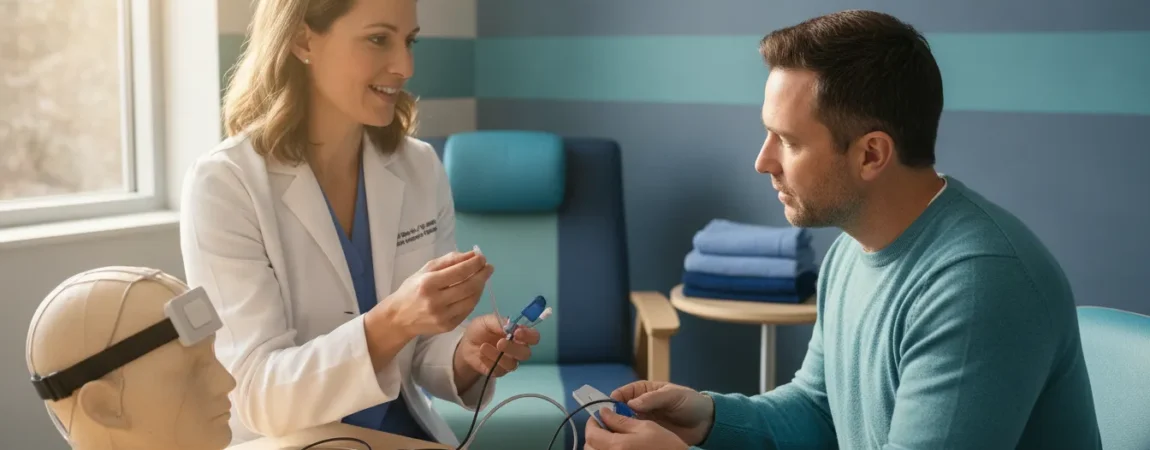
If you searched for how is sleep apnea diagnosed sleep study information, you are probably trying to understand what happens after snoring, gasping, daytime fatigue, or a bed partner’s concern raises a question. Sleep apnea is diagnosed through a medical evaluation and an appropriate sleep study, not through symptoms alone. A qualified medical provider reviews your history, examination, and test results before discussing the diagnosis.
For a broader view of the path from symptoms to testing and care, read the Sleep Apnea and Snoring Education: From Symptoms to Diagnosis guide from Spark Sleep Solutions. This article focuses on the testing pathway and explains where dental sleep medicine fits after a physician diagnosis.
What Happens When You Search “How Is Sleep Apnea Diagnosed Sleep Study”?
Short answer: A sleep physician or another qualified medical provider evaluates your symptoms and history, performs an examination, and may order a home sleep apnea test or overnight polysomnography. The provider interprets the data with your clinical information to determine whether obstructive sleep apnea is present. That interpretation guides the treatment discussion.
The first step is usually a conversation about your sleep and daytime health. Tell the provider whether you snore loudly, wake up gasping, notice pauses in breathing, wake with a dry mouth, or feel unrefreshed despite spending enough time in bed. A bed partner’s observations can be helpful because you may not know what happens while you are asleep.
Information your provider may review
- Nighttime symptoms, such as snoring, choking, gasping, or observed breathing pauses.
- Daytime symptoms, such as sleepiness, morning headaches, difficulty concentrating, or mood changes.
- Health conditions, medications, nasal congestion, alcohol use, and family sleep history.
- Changes in weight, blood pressure, jaw position, or other factors that may affect the upper airway.
- Whether another condition, such as insomnia or a movement-related sleep disorder, could explain some symptoms.
Symptoms can suggest a need for testing, but they cannot establish the diagnosis. For example, snoring may occur without obstructive sleep apnea, while some people with sleep apnea do not realize that they snore. The sleep apnea symptoms in adults resource can help you organize questions before your appointment, but it cannot replace an evaluation.
What the examination contributes
A medical examination may include the mouth, nose, throat, jaw, visible airway structures, blood pressure, and other health factors. The purpose is not to diagnose sleep apnea from appearance alone. It helps the provider understand your risk profile, decide whether testing is appropriate, and select a study that can answer the clinical question.
Bring a medication list, a sleep diary if you keep one, and specific observations from anyone who has watched you sleep. Note when you go to bed, when you wake, how often you awaken, and how rested you feel. These details give the provider context for interpreting a test that captures only one or a few nights.
How Is Sleep Apnea Diagnosed Sleep Study Testing at Home or in a Lab?
Short answer: A home sleep apnea test records a limited set of breathing-related signals while you sleep in your usual environment. In-lab polysomnography records a broader range of signals, often with trained staff present. The sleep physician chooses between them based on your symptoms, medical history, examination, and whether a more detailed evaluation is needed.
Home sleep apnea testing and in-lab polysomnography are different tools. Neither is automatically the right choice for every patient. The ordering provider considers whether the suspected problem is uncomplicated obstructive sleep apnea and whether the study will provide enough information to interpret the concern responsibly.
| Feature | Home sleep apnea test | In-lab polysomnography |
|---|---|---|
| Setting | You use prescribed equipment at home, usually during a typical night. | You spend the night in a sleep center with sensors and trained staff nearby. |
| Signals | Usually focuses on airflow, breathing effort, oxygen, and related signals. | May record breathing, oxygen, heart activity, brain activity, sleep stages, and movements. |
| Experience | It may feel familiar, but you must apply and use the equipment correctly. | The setting and sensors may feel unfamiliar, while staff can address equipment concerns. |
| When it may help | It may suit some adults with suspected uncomplicated obstructive sleep apnea. | It may be preferred when detailed monitoring is needed or another sleep condition is a concern. |
| Next step | Your physician reviews whether the recording answers the diagnostic question. | Your physician interprets the broader report and discusses treatment or further evaluation. |
A home study generally measures fewer signals than a laboratory study. It may estimate sleep time rather than measure every sleep stage directly. That difference can affect how the clinician interprets the recording. If the result is negative or inconclusive but your symptoms remain concerning, the provider may recommend additional testing.
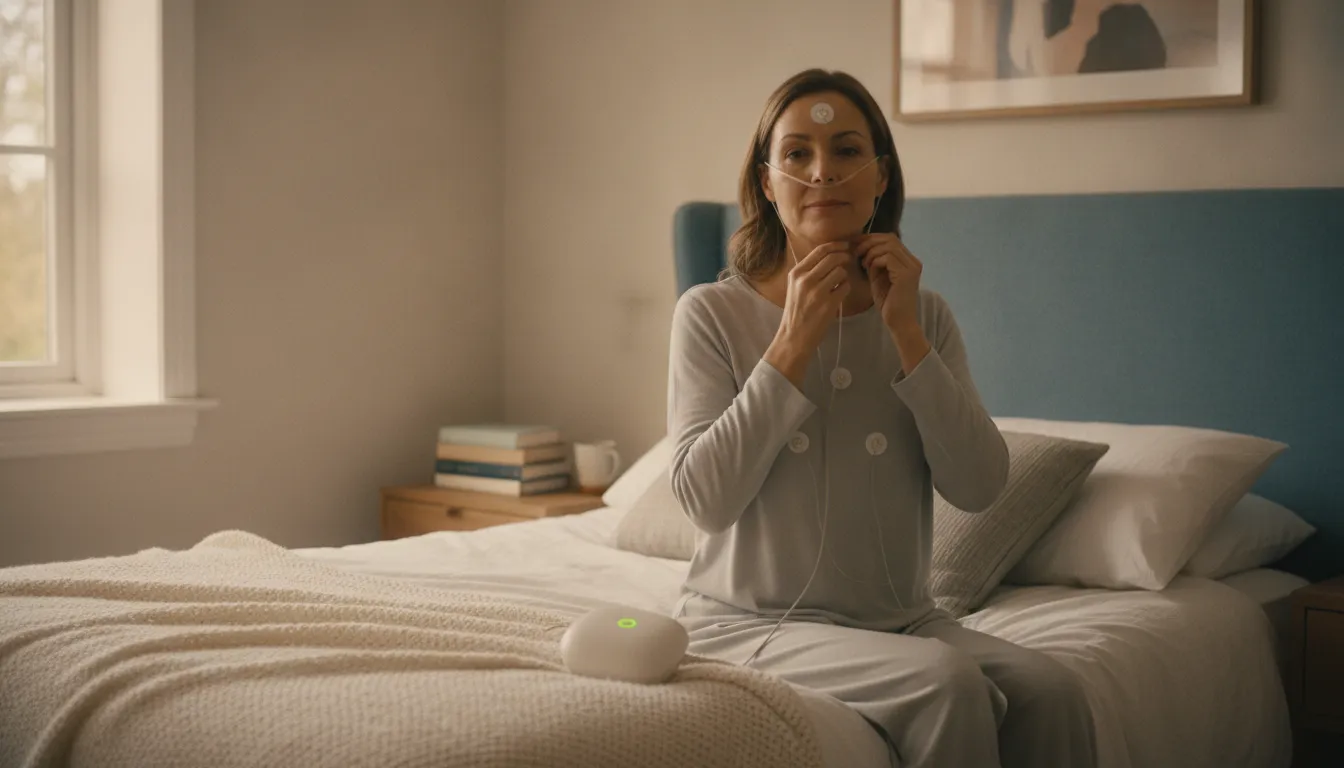
For some patients, an in-lab study provides information that a limited home test cannot. A laboratory study may be considered when the clinical picture is complex, another sleep condition is possible. A prior home test did not explain the symptoms, or the provider needs broader monitoring. In some settings, a split-night study may begin with diagnostic monitoring and continue with treatment-related monitoring when the ordering clinician determines that approach is appropriate.
The National Heart, Lung, and Blood Institute’s sleep apnea diagnosis guidance explains why a provider may use different types of testing. Spark Sleep Solutions also provides information about home sleep apnea testing. Discuss the appropriate test with the medical provider managing your sleep evaluation.
What Does a Sleep Study Report Show?
Short answer: A sleep study report summarizes breathing events and related body signals recorded during sleep. Depending on the test, it may include airflow, breathing effort, oxygen saturation, heart activity, sleep stages, body position, and movements. A qualified provider interprets the report with your symptoms and medical history rather than relying on one number.
A report is a record of an overnight evaluation, not a self-diagnosis tool. The provider considers the quality and scope of the recording, the amount of usable data, and the circumstances of the test. Ask the ordering provider to explain unfamiliar terms and how the findings relate to your symptoms.
Breathing events and oxygen information
Clinicians look for repeated pauses in breathing or episodes in which airflow becomes restricted. They assess how often events occur and how they relate to the recorded sleep time, body position, and other available signals. Oxygen saturation measurements can show whether breathing events are associated with drops in oxygen, but oxygen data should not be interpreted in isolation.
The apnea-hypopnea index, often shortened to AHI, is one measure that may appear in a report. It describes the average number of qualifying breathing events per hour of sleep or recording, depending on the type of study and reporting method. Your provider must explain what the index means in the context of the complete report. Do not use an isolated value from a device, watch, or online calculator to make a diagnosis.
Sleep stages, position, and other signals
In-lab polysomnography can include brain activity that helps identify sleep stages, heart activity, breathing patterns, oxygen levels, and arm or leg movements. Body-position data may show whether events occur more often in one position. The broader record can also give the clinician a reason to investigate another sleep-related concern.
A home sleep apnea test usually captures a narrower set of signals. Because it may estimate sleep time, the provider will interpret it differently from a study that directly measures sleep stages. The Mayo Clinic overview of obstructive sleep apnea diagnosis describes why testing and interpretation should be individualized.
Questions to ask when results are reviewed
- Was the recording technically adequate, and how much usable data did it contain?
- Which type of sleep apnea, if any, does the report support?
- How do the findings relate to my symptoms and other health conditions?
- Do the results suggest that another sleep study or evaluation is needed?
- Which treatment options should we discuss, and what follow-up is recommended?
A report can support a diagnosis, but it cannot tell you which treatment will be best without clinical discussion. Your physician may consider positive airway pressure, positional strategies, custom oral appliance therapy for appropriate patients, or another evidence-based option based on the diagnosis and your health history.
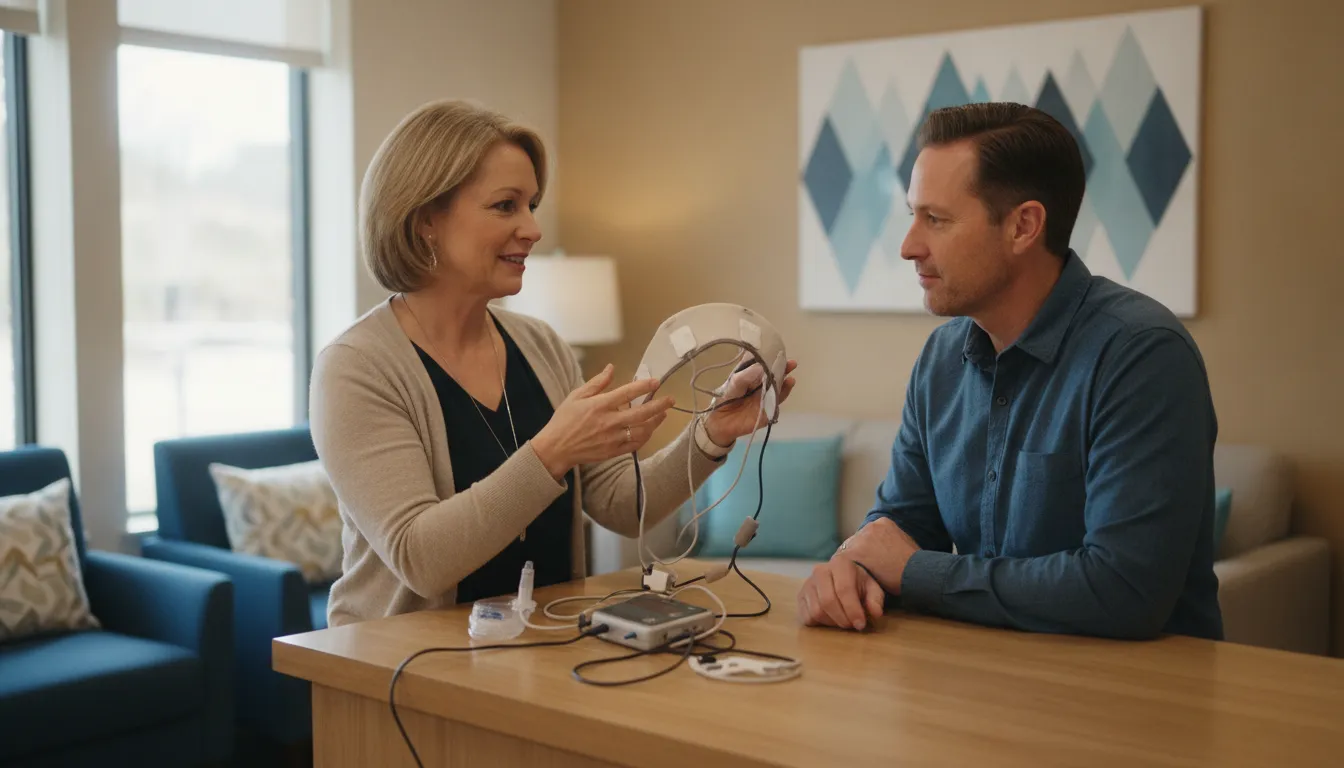
How Sleep Physicians Answer “How Is Sleep Apnea Diagnosed Sleep Study” Questions
Short answer: A sleep physician or another qualified medical clinician evaluates symptoms, orders or refers you for testing, and interprets the results. A dental sleep medicine provider does not replace that diagnosis. After obstructive sleep apnea is confirmed, the dental provider can evaluate treatment options and coordinate care with the sleep physician.
- Discuss symptoms and health history with a qualified medical provider.
- Complete the home or in-lab sleep study that fits your clinical situation.
- Review the report and diagnosis with the ordering provider.
- Discuss treatment options and follow-up based on the findings.
A dentist may recognize signs that warrant medical evaluation, but dental examination alone does not establish obstructive sleep apnea. The medical provider connects the history, examination, sleep study, and possible alternative explanations. That distinction protects patients from treating symptoms without confirming the underlying condition.
The medical provider’s role
The sleep physician or other qualified provider decides which test is appropriate and explains how to complete it. After the study, the provider reviews whether the data are adequate, interprets the findings, discusses the type and severity of the condition, and recommends the next step. This may include treatment, additional testing, or referral to another specialist.
Spark Sleep Solutions’ sleep apnea testing and diagnosis resource provides additional background, but the medical provider managing your evaluation remains responsible for the diagnosis. If you are preparing for an appointment, bring the report, your medication list, and questions about what the result means.
The dental sleep medicine provider’s role after diagnosis
Once obstructive sleep apnea has been diagnosed, a qualified dental sleep medicine provider can evaluate whether oral appliance therapy is clinically appropriate. The evaluation may consider your sleep study, dental health, jaw function, bite, airway findings, comfort needs, and previous treatment experience. The dental provider coordinates with the treating sleep physician and follows the agreed plan.
Dr. Srujal H. Shah, DDS, DABDSM, DASBA, leads Spark Sleep Solutions. The practice focuses exclusively on dental sleep medicine and related orofacial concerns. Its role is to provide dental treatment for diagnosed obstructive sleep apnea, not to diagnose the condition independently. Patients can learn more about the practice’s sleep medicine doctors and credentials before arranging a consultation.
What Happens After a Sleep Apnea Diagnosis?
Short answer: After a diagnosis, your sleep physician reviews the findings and discusses treatment based on the type and severity of sleep apnea, your symptoms, and your health history. Positive airway pressure is an important option. For appropriate patients, including some people who cannot tolerate CPAP, a custom oral appliance may also be considered with physician and dental sleep medicine coordination.
A diagnosis is the beginning of a treatment conversation, not the end of care. Ask your physician what the report means, which options fit your diagnosis, and how follow-up will measure progress. Treatment selection should account for clinical suitability and whether you can use the treatment consistently.
Discuss treatment options with your physician
Positive airway pressure is commonly recommended for obstructive sleep apnea. If CPAP is difficult to tolerate, do not stop or change treatment without speaking with the physician managing your care. Ask whether mask adjustments, pressure support, equipment changes, or another evidence-based approach should be considered.
For some patients, a custom oral appliance may be considered, including some adults with mild to moderate obstructive sleep apnea or people who cannot tolerate CPAP. Oral appliance therapy is not a cure and is not a universal replacement for CPAP. Candidacy requires an evaluation by a qualified dental sleep specialist, coordination with the treating sleep physician, and follow-up as recommended.
Read Spark Sleep Solutions’ oral appliance therapy versus CPAP comparison for a patient-focused overview of how the options differ. The decision should be made with your treating providers rather than from a general article alone.
Plan for follow-up
Follow-up can address comfort, adherence, symptom changes, and whether repeat sleep testing is needed. If you are exploring a custom device, review the oral appliance therapy process and the custom-fitted oral appliance information. Bring your sleep study report to the consultation so the dental provider can review the clinical context.
Spark Sleep Solutions offers more than 100 FDA-approved custom oral appliances and coordinates eligible care through medical insurance, not dental insurance. Device selection depends on clinical factors, dental health, jaw function, and the treatment plan. A provider can explain whether an appliance may be appropriate for you and what follow-up would involve.
Frequently Asked Questions About Sleep Apnea Diagnosis
Short answer: Sleep apnea diagnosis requires a medical evaluation and interpretation of an appropriate sleep study. Home testing may suit some adults, while in-lab polysomnography may be needed when a broader evaluation is appropriate. Your physician should explain the report and next steps.
Can snoring alone diagnose sleep apnea?
No. Snoring can be a symptom, but it can also occur without obstructive sleep apnea. A physician evaluates your symptoms and health history and orders a sleep study when appropriate. A bed partner’s observations are useful to share, but they do not replace medical testing.
Is a home sleep apnea test accurate enough?
A home sleep apnea test can be appropriate for some adults with suspected uncomplicated obstructive sleep apnea. It records fewer signals than an in-lab study and may estimate sleep time. Your physician decides whether it fits your clinical situation and whether additional testing is needed if the result is negative or inconclusive.
What is the difference between AHI and a sleep apnea diagnosis?
AHI is one measure that may appear in a sleep study report. A diagnosis depends on the complete clinical picture, including symptoms, medical history, examination, test quality, and the provider’s interpretation. Do not use one number from a report or consumer device to diagnose yourself.
Who reads a sleep study report?
The ordering sleep physician or another qualified medical provider interprets the report. The provider reviews the recording quality, signals collected, breathing events, oxygen information, and your clinical history. Ask that provider to explain unfamiliar terms and whether the results support additional evaluation or treatment.
Can a dentist diagnose obstructive sleep apnea?
A dental sleep medicine provider supports treatment after a medical diagnosis, but does not replace the medical evaluation. After obstructive sleep apnea is confirmed, the dental provider can assess whether a custom oral appliance may be appropriate and coordinate care with the treating sleep physician.