
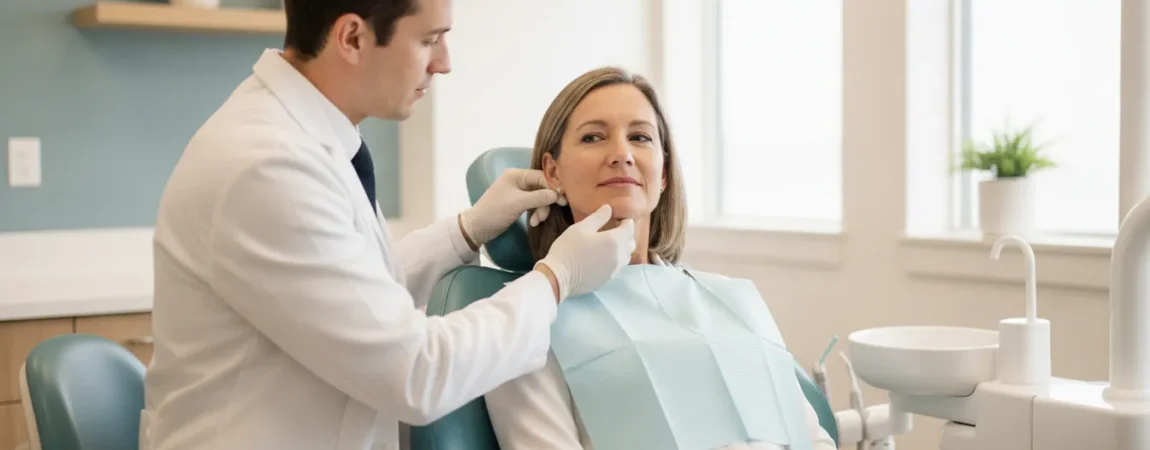
If jaw pain, clicking, stiffness, or trouble opening your mouth has you searching how is TMJ diagnosed, the short answer is clinical, not a single scan. A clinician starts with your symptoms and health history, then examines jaw movement, the joints, and the chewing muscles. Imaging is added only when it can answer a question the exam cannot. There is no one test that identifies every temporomandibular disorder (TMD).
A focused visit can help separate a jaw-joint or muscle problem from toothache, headache, ear pain, or another source. This guide covers what happens in the room, which records to bring, and how a working assessment leads to next steps. For the wider picture of causes, symptoms, and care, start with Spark Sleep Solutions’ TMJ disorder guide.
How Is TMJ Diagnosed During a Clinical Exam?
TMJ disorders are generally evaluated with a detailed symptom history and a focused physical exam. The clinician watches how your jaw moves, checks the joints and chewing muscles, and notes whether familiar pain returns during movement or gentle pressure.
People often say “TMJ” when they mean jaw pain. The temporomandibular joint is the hinge on each side of the jaw, just in front of the ear. TMD is the broader name for a group of conditions that affect the joint, the disc inside it, the chewing muscles, or related structures. The National Institute of Dental and Craniofacial Research describes more than 30 conditions in this group. More than one can be present, so the clinician looks for a pattern rather than one sign.
During the exam you will usually be asked to open and close, move the jaw side to side, and point to where you feel discomfort. The clinician may watch how far and how smoothly the jaw opens, listen for joint sounds. And gently feel the joints and the muscles of the cheeks, temples, and face. Teeth and the bite are checked when they might explain pain or a change in how the teeth meet.
A click or pop by itself does not establish a TMD diagnosis. Painless joint sounds are common and often need no treatment. Pain, locking, limited opening, or trouble chewing matter more, and they are judged together with your history. An online article cannot tell you which pattern you have.
What Should You Tell the Clinician?
Your history shows when symptoms happen, what seems to trigger them, and how they change daily life. Bring the location and feel of the pain, its timing, jaw function, related health issues, and any care you have already tried.
A questionnaire can organize the visit, but it does not diagnose you. Useful notes include:
- When jaw or face symptoms began, and whether they are constant or come and go.
- Where you feel discomfort, what it feels like, and whether it spreads to the temple, ear, face, or neck.
- Whether chewing, yawning, talking, stress, or waking up changes the symptoms.
- Catching, locking, smaller opening, painful sounds, or a change in your bite.
- Recent dental work, jaw injury, headaches, medicines, and treatments already tried.
Mention sleep, snoring, or nighttime clenching if they are part of your story. Those details can shape the conversation. They do not, by themselves, prove the cause of jaw pain or diagnose sleep apnea. A physician diagnoses sleep apnea. Spark Sleep Solutions coordinates with sleep physicians when that evaluation is needed.
If another office has already examined you, bring those notes and any images. Repeating a scan is not always useful, and prior records help the clinician see what has changed. The practice’s TMJ and orofacial pain evaluation is built around this clinical picture and the right next step, not a single machine.

When Are X-Rays, CT, or MRI Used?
Imaging is not required for every person with jaw symptoms. A panoramic or other dental X-ray, CT or cone-beam CT, or MRI is considered when the picture could clarify a structural question the history and exam cannot settle.
Each method shows different tissue. A panoramic dental X-ray gives a broad view of the teeth and jawbones. It does not show the soft disc of the joint the way MRI does. CT or cone-beam CT is better for bone shape. MRI is the usual choice when the question is about the disc or other soft tissue. The right study depends on the question, images you already have, and clinical judgment.
Think of the choices as a short map, not an order set. Your clinician picks a study only when the result could change what happens next.
- A dental X-ray shows teeth and a broad look at jawbone. It may help when tooth pain or injury is in question.
- A CT scan shows bone shape in more detail. It may help when a bone finding would change the plan.
- An MRI shows the disc and other soft tissue. It may help with locking or a suspected disc problem.
| Dental X-ray. | Teeth and jawbone. | Tooth pain or injury. |
| CT scan. | Bone shape. | A bone question. |
| MRI. | Disc and soft tissue. | Locking or disc questions. |
A provider may consider imaging after an injury, when opening stays limited, or when symptoms persist and the exam does not explain them. A scan does not replace the history and exam. Findings have to be read next to your symptoms, because a picture alone does not explain every person’s pain. Mayo Clinic’s review of TMD diagnosis describes the same idea: exam first, imaging when it adds something specific.
Ask what the test is meant to answer, what it cannot show, and who will interpret it. Sometimes another clinician orders or reads the study. You should not expect every visit to end with an MRI or a CT.
Where Does Eccovision Fit, and Where Does It Not?
An Eccovision pharyngometer uses sound waves to estimate the size and shape of parts of the upper airway. It is an airway tool used in dental sleep medicine. It is not a stand-alone test for a temporomandibular disorder, and it does not replace a jaw exam.
At Spark Sleep Solutions, airway measurement can matter when the same visit also involves snoring, possible sleep-disordered breathing, or planning for oral appliance therapy. It adds one piece of information to that broader assessment. The TMJ pathway stays centered on your history, the jaw and muscle exam, and any imaging that is actually indicated.
If you have questions about snoring or sleep apnea along with jaw symptoms, say so. A physician still diagnoses sleep apnea, and the practice coordinates with sleep physicians for that diagnosis and for treatment planning. Oral device therapy is a dental sleep medicine service for appropriate patients. It is not a treatment for every jaw condition, and it is not presented as better than CPAP for everyone. Patients who cannot tolerate CPAP, or who have mild to moderate obstructive sleep apnea. Can ask whether a custom oral device is a reasonable option after a physician’s diagnosis.
What Does a TMJ Assessment Mean for Next Steps?
After the visit, the clinician may explain the most likely findings, whether more information is needed, and which next step fits you. That might be conservative care, another test, a referral, or a follow-up. Not every patient needs imaging or the same plan.
A working assessment is not a promise that one device or one procedure will fix the problem. Many jaw and muscle problems are managed first with education, habit changes, and other conservative care. NIDCR notes that permanent changes to the teeth or jaw, and surgery, are not first-line choices for most people. Your clinician can explain why a step is or is not being offered.
Use the end of the visit to ask plain questions:
- Which findings support the working assessment?
- What other causes were considered, including dental or medical ones?
- Would imaging change the plan, and which type?
- What should you watch for, and when should you follow up?
- If sleep symptoms are part of the picture, who diagnoses those?
Some patients later discuss a custom oral device as one part of individualized jaw or dental sleep care. A device is not right for everyone. Benefits, limits, and follow-up depend on the exam and your health history. Treatment choices, including appliances and when surgery is even discussed, live on the TMJ treatment guide rather than in this visit overview. For sleep apnea, a physician’s diagnosis remains essential.
How Should You Prepare for the Appointment?
Bring a short symptom list, your medicines, and any dental or medical records you already have. Write down when the pain is worst and what you have tried. If another clinician is involved, ask how records can be shared before you arrive. That preparation makes the conversation specific without asking you to diagnose yourself.
Know the difference between a routine evaluation and urgent care. Seek prompt medical attention for severe or rapidly worsening pain, facial swelling with fever. A significant injury, trouble breathing or swallowing, or a jaw that suddenly will not open or close. Those situations are not a wait-for-the-blog-article problem. For persistent but stable jaw pain, limited movement, or symptoms that interfere with chewing or speaking, a scheduled evaluation is a reasonable next step. A separate guide covers when jaw pain should be checked in more detail.
Spark Sleep Solutions is a Bay Area practice focused on dental sleep medicine and orofacial pain, not a general dental office that adds appliances on the side. Dr. Srujal H. Shah is a Diplomate of the American Board of Dental Sleep Medicine and the American Sleep and Breathing Academy. And he completed a mini residency in orofacial pain and TMJ disorders. That background is why the visit can look at jaw symptoms and, when relevant, coordinate sleep-related questions with a physician. It is not a reason to skip the exam or to treat every click as a disorder.
What the Visit Does Not Try to Prove
A TMJ evaluation looks for a working explanation of pain or lost function. It does not grade every click, promise a cure, or decide that an oral device is the right care for every person.
Joint sounds without pain are common. The NIDCR patient overview is clear that painless sounds are not automatically a disorder that needs treatment. If the exam does not reproduce your pain or show a limit in movement, the clinician may say that no TMD label fits right now. That is a useful result. It can point the search toward a tooth, an ear, a headache condition, or simple observation.
You may also hear that symptoms can come from muscles, from the joint, or from both. Muscle tenderness and joint findings are not the same problem, even when they hurt in a similar place. Naming the pattern helps the clinician avoid a plan aimed at the wrong tissue. It does not require you to memorize the category names.
Sleep questions belong in the visit only when you raise them or when the history makes them relevant. Snoring, witnessed pauses, or trouble tolerating CPAP are reasons to involve a sleep physician. They are not a shortcut to a jaw diagnosis, and a jaw diagnosis is not a shortcut to a sleep diagnosis. If both are on the table, each one still needs its own evaluation.
Leave with a clearly stated next step, even if that step is no imaging today and a return visit if opening stays limited. If you are unsure what was found, ask the clinician to restate it in one or two sentences before you go. A clear summary is part of a complete answer to how a TMJ problem is assessed.
Frequently Asked Questions
Can a dentist diagnose a TMJ disorder?
A dentist with the right training can evaluate many jaw and muscle concerns and recognize patterns that fit a TMD. The right clinician depends on your symptoms. If the cause looks medical, dental in another way, or outside jaw care, your provider may coordinate a referral. Spark’s orofacial pain team evaluates jaw symptoms and works with other clinicians when a broader look is needed.
Does a clicking jaw mean I have a TMJ disorder?
No. A painless click or pop alone does not establish a TMD diagnosis. Painless joint sounds are common. A clinician weighs pain, movement, function, history, and the exam together. Painful clicking, locking, or a jaw that will not open fully should be discussed with a qualified provider.
Do all TMJ evaluations require an MRI or CT scan?
No. Many evaluations begin and end with history and examination. MRI and CT show different structures, so one is not a default upgrade over the other. Your clinician can explain whether any image would change the plan.
Can a pharyngometer diagnose TMJ?
No. A pharyngometer estimates aspects of the upper airway. It belongs in dental sleep medicine assessments, not as a TMJ test. A temporomandibular disorder is evaluated from symptoms and jaw function, with imaging only when it is clinically useful.
How long does a TMJ specialist appointment take?
Length varies by practice and by how complex the story is. Ask when you schedule, and leave time for history, the exam, prior tests, and your questions. Bringing records and a short symptom list usually makes the visit more useful than trying to remember everything in the chair.
This article is education, not a diagnosis or a treatment plan. If jaw symptoms are affecting eating, speaking, or sleep, a clinician who examines you can tell you what the findings mean.