
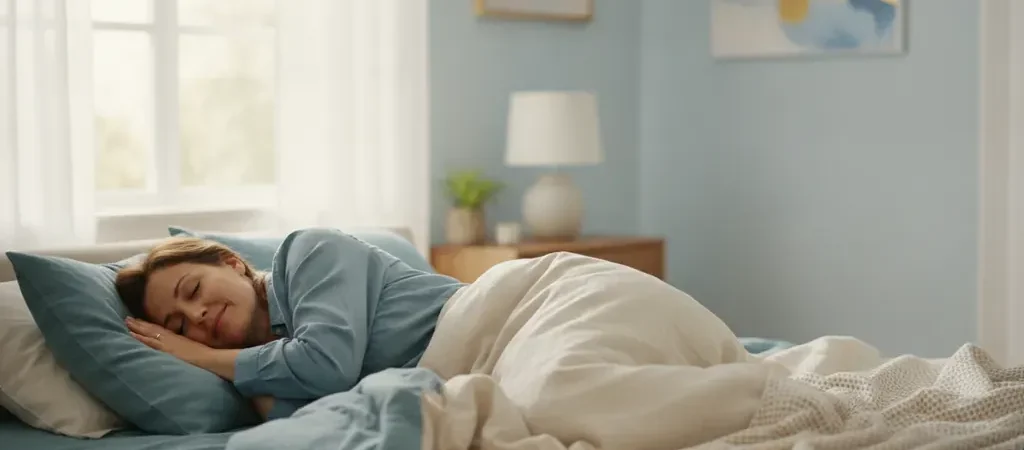
If your breathing is worse when you sleep on your back, positional therapy for sleep apnea may be one part of a broader treatment plan. This approach uses sleep position, behavioral strategies, or a positioning device to reduce time spent supine, the position in which gravity can make airway narrowing more likely. It can be useful for some people, but it is not a universal solution and should be matched to your sleep study and clinical needs.
Sleep apnea must be diagnosed by a qualified medical professional. The broader sleep apnea and snoring education resources can help you understand symptoms and testing. While a dental sleep medicine practice can coordinate with your sleep physician and help evaluate treatment options, including custom oral appliance therapy when appropriate.
What is positional therapy for sleep apnea?
Positional sleep apnea is a pattern of obstructive sleep apnea in which breathing interruptions are substantially more frequent or severe in one sleep position. Usually on the back, than in another position. The pattern is identified through a sleep study, not by symptoms alone. A report may show differences in the apnea-hypopnea index, oxygen levels, or respiratory events between supine and non-supine sleep.
Positional therapy is a behavioral treatment intended to help a person avoid the position that worsens breathing. The American Academy of Sleep Medicine describes it as an option for people whose breathing problems occur mainly while sleeping on their back and are less pronounced when sleeping on their side or stomach. The AASM patient resource on positional therapy also explains that the approach may be used alone or alongside another treatment.
The important distinction is between a position-related pattern and a diagnosis. Waking with a dry mouth, snoring, morning headaches, or daytime fatigue does not tell you whether your apnea is positional. Those symptoms can have several causes. A sleep physician should interpret the sleep study and determine whether positional therapy is appropriate.
How does body position affect airway collapse?
Obstructive sleep apnea occurs when the upper airway repeatedly narrows or closes during sleep. Sleep relaxes the muscles that help support the throat. In some people, lying on the back allows the tongue and other soft tissues to move toward the back of the throat. Gravity, anatomy, nasal breathing difficulty, body weight, and sleep-stage changes can all influence how much the airway narrows.
Side sleeping can reduce the gravitational effect for some patients, but changing position does not change every factor that contributes to OSA. A person may still have airway obstruction while sleeping on the side, especially during deeper or rapid eye movement sleep. This is why a device or sleep-position strategy should not be treated as proof that apnea has been resolved.
A sleep study can provide more useful information than a bedroom experiment. It may show how much time you spent in each position, whether respiratory events occurred in non-supine sleep, and whether oxygen levels changed. If the study contains little non-supine sleep, the apparent positional pattern may be difficult to interpret. Your physician may recommend additional evaluation rather than assuming that side sleeping is enough.
What types of positional therapy are available?
Positional therapy can range from a simple behavioral plan to a purpose-built device. The best option depends on the pattern shown by testing, comfort, mobility, sleep habits, and whether another OSA treatment is also needed.
| Approach | How it works | What to discuss with a clinician |
|---|---|---|
| Behavioral positioning | Uses sleep habits, pillows, or a clinician-approved setup to encourage side sleeping. | Comfort, safety, consistency, and whether the strategy changes breathing on follow-up. |
| Wearable positioning device | Uses a barrier or gentle vibration to discourage rolling onto the back. | Fit, tolerance, device data, current indications, and whether symptoms continue. |
| Combination plan | Pairs positional strategies with CPAP, an oral appliance, or another treatment. | Prescribed settings, objective testing, treatment goals, and follow-up timing. |
Behavioral and environmental strategies
Some people begin with a structured effort to make side sleeping easier. This may include arranging pillows for support, adjusting the sleep surface, or using a clinician-approved method that makes back sleeping less comfortable. These strategies should be practical enough to use consistently and should not create a fall risk, pain, or restricted breathing.
Informal methods can be difficult to standardize. A strategy that keeps you off your back for part of the night may not prevent position changes later. If symptoms persist, the next step should be clinical review rather than adding more restrictive devices on your own.
Wearable positioning devices
Some devices create a physical barrier that discourages rolling onto the back. Others use gentle vibration when a sensor detects a change toward supine sleep. The goal is usually to prompt a position change without fully waking the person. Depending on the product, data about position changes or related sleep signals may be available for review with a clinician.
The older Spark article about Slumberbump and Zzoma discusses two named examples. That product comparison is different from this broader guide. Device availability, indications, clearance status, and prescribing requirements can change, so ask your sleep physician or qualified clinician for current guidance before purchasing or using one.
Positional therapy used with another treatment
Positional therapy does not have to be an either-or decision. A clinician may consider it as an adjunct when a person has residual events in a particular position. Needs a strategy for travel, or is working toward a more complete treatment plan. Whether it adds value depends on objective testing and how well the primary treatment is working.
For a person using CPAP, position can affect pressure needs and mask comfort, but positional therapy should not be used to change prescribed settings without guidance. For a person using an oral appliance, sleep position may be one factor in deciding whether the appliance needs further adjustment or whether follow-up testing is needed. The plan should be individualized rather than based on a general claim that one therapy is better than another.
What does the evidence say about positional therapy?
Research supports a measured view. Positional therapy can improve breathing measures for some people compared with no positional intervention, particularly when the sleep study shows a clear position-related pattern. However, evidence is not the same as a guarantee for an individual patient. Studies have included different devices, definitions, follow-up periods, and patient populations.
A Cochrane review of positional therapy for obstructive sleep apnea found that CPAP generally reduced the apnea-hypopnea index more than positional therapy in the trials it evaluated. While positional therapy could improve some measures compared with no positional therapy. The review also noted limitations in the available evidence, including small studies and limited long-term data. In practical terms, a patient may find a positional approach easier to use. But ease of use does not automatically mean that it controls OSA as effectively as another treatment.
More recent reviews continue to evaluate vibration-based and other positional devices. They do not eliminate the need for diagnosis, follow-up, or objective assessment. If a clinician recommends positional therapy, ask how success will be measured and what to do if snoring, fatigue, witnessed pauses, or abnormal oxygen levels continue.
Who may benefit from positional therapy?
Positional therapy may be considered when several factors line up. It is best treated as a monitored part of care, not as a test you pass by simply waking up on your side. Keep a record of symptoms, comfort, and any changes your clinician asks you to track. That information can make follow-up visits more useful.
- A sleep study shows that breathing events are substantially worse on the back.
- Breathing improves in another position, with enough non-supine sleep to make the finding meaningful.
- The person can comfortably and safely maintain a different sleep position.
- The clinician has considered OSA severity, oxygen findings, sleep stage, anatomy, and other health conditions.
- There is a clear plan to monitor symptoms and, when appropriate, repeat testing.
It may be less suitable as a stand-alone approach when events remain frequent in side sleeping. Oxygen levels are concerning, positional sleep is not tolerated, or the person has a more complex sleep-related breathing disorder. It is also not a substitute for medical evaluation when symptoms suggest possible OSA.
When is positional therapy alone not enough?
Seek a clinician’s guidance if you continue to have loud snoring, witnessed breathing pauses, gasping, morning headaches, or excessive daytime sleepiness. Those symptoms do not prove that treatment has failed, but they are reasons to review the plan. Do not assume that sleeping on your side has treated the underlying condition simply because snoring seems quieter on some nights.
Positional therapy may also be insufficient when the sleep study shows meaningful obstruction in multiple positions. In that situation, a sleep physician may discuss CPAP, custom oral appliance therapy, weight and lifestyle support, surgery, or another evidence-based option. The choice depends on the diagnosis, severity, anatomy, medical history, preferences, and ability to use the treatment consistently.
For adults who cannot tolerate CPAP or who need another approach for diagnosed obstructive sleep apnea. A custom oral appliance may be considered in coordination with a sleep physician. Spark Sleep Solutions provides specialized dental sleep medicine care and can explain how custom oral devices are evaluated, fitted, and monitored. Oral appliances manage OSA for appropriate patients; they are not a cure.
Bring your sleep study, current treatment information, and a list of questions to an evaluation. Spark Sleep Solutions can coordinate with your treating physician and discuss medical insurance coverage for appropriate oral appliance care.
How positional therapy fits into a complete OSA plan
A thoughtful plan usually follows a sequence rather than a single product recommendation:
- Confirm the diagnosis. A physician or qualified sleep professional interprets the sleep study and distinguishes obstructive sleep apnea from other sleep-related breathing disorders.
- Identify the pattern. Review position, sleep stage, oxygen levels, respiratory events, symptoms, and the amount of recorded sleep in each position.
- Discuss appropriate options. Consider positional therapy, CPAP, oral appliance therapy, or other treatment based on clinical findings and patient preferences.
- Use the selected treatment consistently. Comfort, travel, cleaning, fit, and daily routines can affect whether a treatment is sustainable.
- Confirm effectiveness. Follow-up symptoms and, when recommended, repeat sleep testing help determine whether the treatment is managing OSA adequately.
For patients considering oral appliance therapy, Spark Sleep Solutions may evaluate oral health, jaw function, airway factors, and treatment goals. The practice offers more than 100 FDA-approved custom oral appliances and uses digital assessment tools to help match care to the patient. Device selection remains a clinical decision, not a promise that any particular appliance will work for everyone.
For a broader starting point, review the sleep apnea and snoring education resources, including symptoms, testing, and treatment considerations. Then discuss your personal results with a qualified professional.
Frequently asked questions
Is positional therapy a cure for sleep apnea?
No. Positional therapy can help manage position-related obstructive sleep apnea for some patients, but it does not cure sleep apnea. Effectiveness should be assessed with clinical follow-up and, when recommended, objective sleep testing.
Can I diagnose positional sleep apnea at home?
No. Noticing that you snore more on your back can be useful information, but it is not a diagnosis. A sleep study and professional interpretation are needed to determine whether breathing events are position-dependent.
Is positional therapy better than CPAP?
There is no universal answer. CPAP and positional therapy work differently, and studies suggest CPAP may reduce breathing events more strongly in some comparisons. A clinician should consider effectiveness, tolerance, safety, and the findings from your sleep study.
Can positional therapy be combined with an oral appliance?
Sometimes. A sleep physician and qualified dental sleep medicine provider may consider both approaches when the clinical pattern supports it. Follow-up is important to determine whether the combined plan is managing obstructive sleep apnea adequately.
What should I do if I think my sleep apnea is worse on my back?
Share that observation with your treating sleep physician and ask whether your sleep study shows positional OSA. Do not change prescribed treatment or rely on a device without discussing your symptoms, diagnosis, and treatment goals with a qualified professional.