
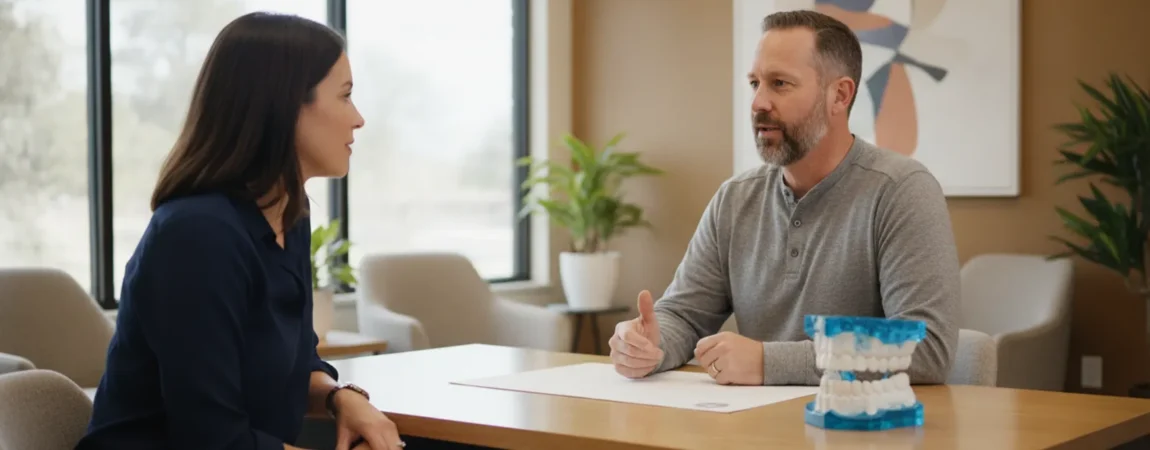
Sleep apnea treatment for veterans begins with an evaluation by a qualified physician and a conversation about your symptoms, diagnosis, and treatment history. Veterans may receive care through different settings; your clinician can explain the route that applies to you. If an oral appliance is being considered, a dental sleep medicine provider can coordinate with the sleep physician responsible for diagnosis.
What should veterans know about sleep apnea?
Obstructive sleep apnea (OSA) occurs when the upper airway repeatedly narrows or closes during sleep, disrupting breathing. Loud snoring, witnessed pauses, gasping, waking unrefreshed, or daytime sleepiness can be reasons to ask a clinician about evaluation. These signs alone do not confirm OSA, and they cannot establish its severity. A physician evaluates your history and may arrange a sleep study.
Not every sleep-related breathing condition is the same. The type of sleep apnea and the findings in a sleep study guide treatment discussions. A resource from the VA explains testing and treatment basics for veterans; it is educational information, not a personal determination of eligibility or benefits. See the VA Sleep Apnea training resource.
Veterans may encounter sleep care through VA services, community clinicians, or more than one care setting. The specific pathway depends on personal circumstances. This article is general education, not a decision about VA eligibility, disability ratings, or benefits. Keep those questions with the appropriate VA office or benefits professional.
How can you start an evaluation?
Begin with the clinician responsible for your sleep care, such as a primary care provider or sleep physician. Describe what you notice, when it happens, and how it affects your day. If someone shares your bedroom, their observations about snoring, breathing pauses, or gasping may help you give a clearer account.
Before the appointment, gather a list of medications, relevant health conditions, and prior sleep tests or treatments. If you have used a prescribed therapy, note what works, what is difficult, and when the difficulty occurs. For example, distinguish trouble getting started from discomfort that develops later in the night. Specific details give the clinician a better basis for discussing adjustments or other approaches.
If you have not been diagnosed, ask whether an evaluation is appropriate. Symptoms alone cannot diagnose OSA. Spark Sleep Solutions coordinates sleep apnea testing and diagnosis through partnered labs and physicians in the Bay Area; its dental sleep medicine care focuses on oral appliance treatment after diagnosis. For a plain-language overview, read what sleep apnea means.
If you already have a diagnosis, request a copy of your sleep-study report and the clinician’s interpretation. If the report is not available, ask the office that arranged the study how to obtain it. Bring the report and current treatment information to discussions with another clinician, rather than relying on memory or a summary from a different visit.
What should you ask after a diagnosis?
Use your appointment to understand both the findings and the plan. It can help to ask for explanations in everyday terms and write down answers. Consider asking:
- What type of sleep apnea was identified, and what does my sleep-study report show?
- Which treatment options fit my diagnosis and health history?
- What is the goal of the recommended treatment, and how will we assess whether it is helping?
- What should I do if I cannot use or tolerate the recommended approach?
- When should I follow up, and which clinician is coordinating the plan?
- What records should be shared with other members of my care team?
Ask the sleep physician to explain the follow-up plan before you leave. Treatment is not simply a choice of device; it involves appropriate selection, use, and review. Do not stop or change a prescribed treatment without discussing it with your clinician. If something is uncomfortable or difficult to maintain, report the problem so the care team can advise you.
Where might oral appliance therapy fit?
Continuous positive airway pressure (CPAP) is an established treatment. Some patients have difficulty tolerating it, while others use it as prescribed. For selected people with obstructive sleep apnea, a physician may discuss a custom oral appliance as another option. Suitability depends on the clinical situation; an appliance is not appropriate for everyone and does not cure sleep apnea.
A custom oral appliance is worn during sleep and is designed to help maintain airflow by positioning the lower jaw or tongue. A dental sleep medicine clinician evaluates oral health and jaw function and determines whether an appliance may be appropriate. The sleep physician who diagnosed the condition should remain involved. Follow-up and testing, as advised by the treating clinicians, are important to assess response.
Spark Sleep Solutions focuses on dental sleep medicine and offers more than 100 FDA-approved custom oral devices. The number of options does not mean every device fits every patient; selection is individual. Dr. Srujal Shah holds dual board certifications, DABDSM and DASBA. Learn more about custom oral devices for sleep apnea.
For an overview of available approaches, review the practice’s sleep apnea and snoring treatment options. The dedicated page explains sleep apnea treatment care and provides context for a discussion with your physician. That information can help you prepare questions, but it cannot determine which treatment is right for you.
How do CPAP and an oral appliance differ?
The two approaches work differently and involve distinct routines. The table summarizes practical points to discuss, not a ranking or an individual recommendation. Your sleep physician can explain how diagnosis, severity, health history, and treatment preferences affect the decision.
| Consideration | CPAP | Custom oral appliance |
|---|---|---|
| How it is used | A device delivers pressurized air through a mask during sleep. | A custom-fitted oral device is worn during sleep. |
| Clinical guidance | A sleep physician or qualified sleep-care team prescribes and monitors treatment. | A dental sleep medicine clinician provides the device in coordination with the diagnosing sleep physician. |
| Fit and adjustment | Equipment settings and mask fit may need clinical review. | The dental clinician fits and adjusts the appliance. |
| Follow-up | Follow the care team’s monitoring and review plan. | Follow-up considers comfort, fit, and treatment response, with physician coordination and testing as advised. |
| Potential role | An established treatment that may be recommended based on the clinical evaluation. | A possible alternative for selected patients, including some who cannot tolerate CPAP. |
If you are considering a change, ask your physician how to proceed safely and what follow-up would be needed. If an oral appliance is discussed, ask how the dental provider and sleep physician will share findings and who will arrange any recommended testing.
How can you coordinate care and coverage questions?
Keep your records in one place and make sure each clinician knows who is managing diagnosis and treatment. With your permission, ask whether your sleep physician and dental sleep medicine provider can exchange the relevant report and recommendations. A sleep-study report, current treatment details, and notes about difficulties can make the discussion more specific and reduce the need to reconstruct the history at each visit.
Coverage depends on your plan and circumstances. Do not assume VA benefits, private medical insurance, or a referral automatically covers a particular service. Ask the relevant benefits office or insurer about eligibility, referral requirements, authorization, and documentation. Spark Sleep Solutions works with medical insurance and can discuss coverage questions; treatment is billed through medical insurance, not dental insurance.
When calling an insurer or benefits office, keep the questions concrete: Is this service included under my plan? Is a referral or prior authorization needed? Which documents should the clinician provide? How will I receive a decision? Record the date, the office contacted, and any reference number you are given. These notes do not guarantee coverage, but they help you follow up with the right office if information is incomplete.
Spark Sleep Solutions serves Bay Area communities through locations in San Jose, Los Gatos, San Ramon, Sunnyvale, Santa Cruz, and Monterey. Its practice information describes its specialized focus, and the locations and contact page can help you identify a convenient next step.
How can you prepare for the next appointment?
A short written summary can make a visit easier to use. Include when symptoms began, what a partner has observed, prior test dates, treatments tried, and the main issue you want addressed. Put the most important concern first. For example, if your main question is whether a custom appliance could be considered, say so early and bring the diagnosis and test report if available.
Keep questions separate from assumptions. Rather than deciding that a treatment has failed based on one difficult night, describe what happened and ask whether changes or a different approach may be appropriate. If the clinician recommends a next step, write down who will arrange it and when you should expect follow-up. If another office needs to send a record, clarify which office will request it.
For patients already using treatment, a brief log may be useful: dates of difficulty, what you experienced, and any steps you took. Share it with your clinician rather than making unsupervised changes. If several clinicians are involved, ask which one should receive updates first and how urgent questions should be handled.
Frequently asked questions
Can symptoms alone establish that I have sleep apnea?
No. Snoring, gasping, or fatigue can prompt a conversation, but a physician must evaluate and diagnose sleep apnea. A sleep study may be part of that process.
Does this article determine whether I qualify for VA benefits?
No. Eligibility and disability decisions depend on individual circumstances and should be discussed with the appropriate VA office or qualified benefits professional. The care pathway for diagnosis and treatment is a separate clinical question.
Can every veteran use an oral appliance instead of CPAP?
No. A custom appliance is a possible option for selected patients with obstructive sleep apnea. The sleep physician and dental sleep medicine clinician should assess suitability and coordinate follow-up.
What should I bring to an oral appliance discussion?
Bring your sleep-study report and interpretation if available, a list of current and prior treatments, relevant medication and health information, and questions about comfort, monitoring, and communication between clinicians.
Working with your physician and sharing clear records can help you take an informed, coordinated next step in sleep apnea care.
