
A custom oral appliance is only as effective as the fit it achieves and the adjustments that follow. For patients seeking a non-invasive option for obstructive sleep apnea, the fabrication process is therefore an important part of the treatment experience, not a minor technical detail.
3d intraoral scanning oral appliance fabrication uses a digital model of your teeth and bite to replace traditional impression molds, supporting a more precise and reproducible fit and clearer titration adjustments. The process can also be more comfortable than conventional impressions.
Request An Appointment to find out whether 3D intraoral scanning can support your oral appliance therapy plan.
That precision supports comfort and consistent use, while your sleep physician and dental sleep medicine provider coordinate care around your diagnosis and treatment needs. To understand how oral appliance therapy compares with CPAP, review our oral appliance therapy vs CPAP guide. The first step is seeing how the scan captures the details needed for a custom device.
What Is 3D Intraoral Scanning in Dental Sleep Medicine?
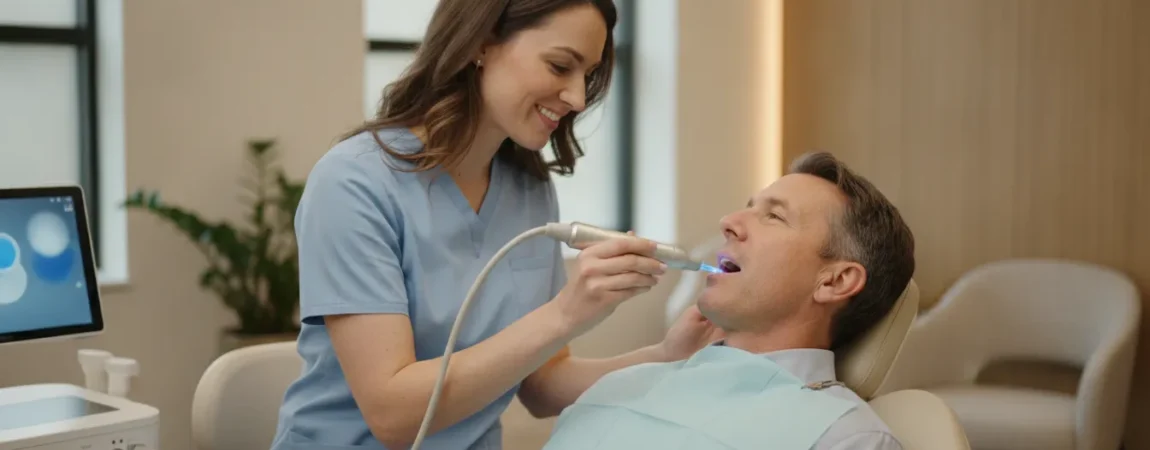
3D intraoral scanning uses a small camera wand to create a detailed digital model of your teeth, gums, and bite. Instead of biting into a tray filled with impression putty, you relax while the clinician guides the wand through your mouth. The scanner captures a series of images and combines them into a three-dimensional record that can be viewed immediately.
In dental sleep medicine, that digital record is used to design a custom oral device for obstructive sleep apnea or snoring. The goal is not simply to make an appliance that fits over your teeth. It is to create a device that can be worn consistently and adjusted carefully as your treatment progresses.
How the scanner captures your bite
The wand takes precise images of the upper and lower dental arches. It also records how those arches meet when you close your mouth. This bite information helps the clinical team and laboratory create an appliance that matches your anatomy rather than relying on a physical mold that can be distorted or difficult to inspect.
Research and industry reporting commonly describe modern intraoral scanners as capable of trueness in the range of about 50 micrometers, with reported results varying by scanner and scanning conditions. A micrometer is one-thousandth of a millimeter, so this level of detail helps explain why digital scanning is useful for custom fabrication. It does not mean that a scan alone guarantees successful treatment. Clinical examination, device design, fitting, and follow-up adjustments remain essential.
Why digital records matter for oral appliance therapy
A precise digital model gives the fabrication team a reproducible starting point. Spark Sleep Solution uses digital 3D intraoral scanning to replace traditional, often uncomfortable impression molds and support precise custom device fabrication. The process can improve comfort during the appointment and help the finished appliance fit more accurately, which may support better day-to-day compliance.
Digital records can also make adjustments more deliberate. Oral appliance therapy often involves titration, or carefully advancing the device to help manage obstructive sleep apnea while monitoring comfort and clinical response. A reliable record of your teeth and bite supports that process, especially when the appliance needs refinement or replacement.
This technology is one part of a broader, physician-coordinated treatment plan. A sleep physician diagnoses sleep apnea, while a qualified dental sleep medicine team evaluates whether a custom oral device is appropriate. If you are comparing treatment options, Spark’s guide to oral appliance therapy vs CPAP explains how these approaches differ and why individual factors matter.
For patients who find traditional impressions unpleasant, the digital approach offers a more comfortable experience without sacrificing the detailed information needed for custom care. Spark’s use of 3D scanning reflects its focus on specialized dental sleep medicine rather than one-size-fits-all devices.
How Digital Impressions Replace Traditional Molds
For many patients, the impression appointment has been one of the least comfortable parts of having a custom oral appliance made. Traditional impressions use a tray filled with pliable material that is pressed over the teeth while it sets. The process can feel bulky, trigger a gag reflex, and leave an unpleasant taste or mess. If you have sensitive teeth, a strong gag reflex, or anxiety about dental procedures, that experience may add unnecessary stress to an important step in treatment.
A digital impression takes a different approach. Instead of placing impression material in your mouth, the clinician guides a small scanning wand over the surfaces of your teeth and gums. The wand captures a series of images and combines them into a detailed three-dimensional model. The scan is completed in seconds to minutes, depending on the anatomy and the information needed, and you can breathe and communicate normally throughout the process.
| Aspect | Traditional impression mold | Digital 3D intraoral scan |
|---|---|---|
| Method | Tray with impression material pressed over the teeth | Small camera wand guided over the teeth and gums |
| Comfort | Can trigger gagging, bulk, taste, and mess | No material in the mouth; breathe and talk normally |
| Accuracy and fit | Physical mold subject to handling variables and distortion | Detailed digital model supports a precise, reproducible fit |
| Fabrication workflow | Physical mold packaged and shipped to the lab | Digital files transferred securely, often faster turnaround |
A more comfortable experience
Digital 3D intraoral scanning eliminates traditional uncomfortable impression material from the procedure. There is no tray full of putty to hold in place and no need to wait while material sets around your teeth. The clinician can pause, review the scan, and rescan a small area if necessary. That makes the appointment more manageable for patients who have previously avoided impressions because of gagging or discomfort.
Comfort is not the only advantage. A clean digital model gives the clinical and laboratory teams a consistent representation of your bite and tooth surfaces. The scan can be reviewed on screen before the appliance is fabricated, helping the team identify incomplete areas and reduce the need to repeat the impression process.
From scan to appliance design
With a traditional impression, a physical mold must be handled, packaged, and transported before the laboratory can use it. A digital scan can be transferred securely to the fabrication team without shipping physical models. This streamlines communication and can support a faster turnaround, while giving the team a precise digital foundation for designing your custom oral appliance.
Fit matters because an appliance must remain comfortable enough for consistent use while positioning the jaw as prescribed by your sleep clinician. Digital scanning supports a better fit and a more reproducible fabrication process, although the scan is one part of a broader clinical workflow. Your evaluation, bite record, appliance design, adjustments, and follow-up all contribute to treatment planning.
If you are exploring 3D intraoral scanning for custom oral appliances, ask how the technology fits into your care plan. A qualified dental sleep medicine team can explain what to expect and coordinate treatment with the physician who diagnosed your obstructive sleep apnea.
How 3D Intraoral Scanning Refines Oral Appliance Fabrication
A precise digital model gives the clinical and fabrication teams a more reliable starting point for a custom oral appliance. Instead of relying on a physical impression that can contain distortions or require repeated handling. The scan captures the shape of your teeth and oral structures as digital information that can be reviewed, stored, and used throughout the fabrication process.
That accuracy matters because an oral appliance must fit securely and comfortably while positioning the lower jaw as prescribed. A device that feels bulky, unstable, or uncomfortable may be harder to wear consistently. Spark Sleep Solution uses digital 3D intraoral scanning to support a more precise fit, which can improve comfort. Long-term compliance, and the likelihood that the appliance can be used as part of an effective treatment plan.
A precise scan supports a more accurate fit
Digital scanning helps capture the contours needed to design an appliance around your individual anatomy. The result is not a generic device selected from a standard size range. It is a custom oral appliance fabricated from a detailed model of your mouth. Precision fit is important for long-term oral appliance therapy efficacy in managing obstructive sleep apnea, because the appliance must remain in position during sleep and deliver the intended mandibular advancement.
Fit also affects the everyday experience of treatment. When an appliance is stable and appropriately shaped, it may be less distracting during sleep and less likely to create avoidable pressure points. Comfort alone does not determine whether treatment works, and scanning does not replace clinical evaluation or follow-up testing. It can, however, give the dental sleep medicine team better information for designing a device that you can use consistently.
Digital files make fabrication more reproducible
A digital workflow allows the design and fabrication information to be reproduced with greater consistency. The scan can be reviewed as the appliance is planned, helping the team preserve the intended fit and design details rather than relying only on a single physical mold. Customized device fabrication enabled by 3D technology also supports the precise adjustments needed for oral appliance titration.
Reproducibility is especially useful when an appliance needs refinement. If the design must be modified, the digital model provides a reference for the next step. It does not eliminate the need for careful clinical judgment, laboratory quality control, or communication with your sleep physician. It helps those professionals work from clearer, more consistent information. Research on custom mandibular advancement devices likewise emphasizes that treatment effectiveness depends heavily on the accuracy of the clinical steps used for fabrication and adjustment. Review the research on fabrication accuracy and custom mandibular advancement devices.
Better adjustment supports ongoing treatment
Oral appliance therapy is often an individualized process. The initial device position may need to be adjusted gradually based on comfort, symptoms, examination findings, and follow-up evaluation. Digital records can support that process by preserving the original model and making the fabrication workflow more precise and repeatable. Advances in digital fabrication and intraoral scanning have been associated with improvements in appliance fit, titration precision, and treatment monitoring. Read the clinical review of digital advances in oral appliance therapy.
These benefits should be understood in context. A scan does not diagnose sleep apnea, determine candidacy by itself, or guarantee a particular outcome. A sleep physician diagnoses obstructive sleep apnea, while a qualified dental sleep medicine provider evaluates the oral appliance option and coordinates care. If you are comparing treatment approaches, our guide to oral appliance therapy vs CPAP explains how a custom device may fit into care when CPAP is not tolerated or another clinically appropriate alternative is being considered.
By combining an accurate digital model with careful design, fabrication, titration, and follow-up, 3D intraoral scanning helps make oral appliance therapy more individualized and manageable. The goal is not technology for its own sake. It is a better foundation for a device that fits your anatomy, supports consistent use, and remains connected to a clinically supervised sleep apnea treatment plan.
What to Expect During a 3D Intraoral Scan Appointment
A 3D scan appointment at Spark Sleep Solution is designed to be straightforward, comfortable, and focused on the details needed to create your custom oral appliance. Your visit begins with a consultation with the dental sleep medicine team. The team reviews your goals, relevant dental information, and the treatment plan coordinated with your sleep physician.
A physician must diagnose sleep apnea. Spark’s role is to provide dental sleep medicine care and determine whether a custom oral device may be appropriate within that diagnosis and care plan. If oral appliance therapy is selected, the scan captures a precise digital model of your mouth without traditional impression material.
What happens during the scan
- Review and preparation: The team explains the appointment and answers questions before scanning begins. You can let the clinician know if you have a sensitive gag reflex, jaw discomfort, or any other concern that could affect your comfort.
- Upper-arch scan: The clinician guides a small scanning wand through your mouth to record the surfaces of your upper teeth and surrounding structures. The wand captures images as it moves, rather than pressing putty against your teeth.
- Lower-arch scan: The same process is used to capture your lower arch. The clinician can review the developing digital model during the appointment and rescan any area that needs additional detail.
- Bite and protocol position: You will be guided into the bite position required for the planned appliance. Recording this relationship is important because a mandibular advancement device is designed around how your upper and lower jaws relate to one another. For more background, read about mandibular advancement device mechanics.
- Digital review and fabrication: Once the scan is complete, the digital files are reviewed and sent to a precision fabrication laboratory. The data supports a reproducible design and the adjustments that may be needed as your treatment is titrated.
Most patients find the scanning process easier than a traditional tray-and-putty impression. It is generally completed in minutes, and there is no gagging putty, messy impression material, or physical mold to store. Because the scan is digital, the team can work from a detailed model while preserving a record that can support future adjustments or replacement needs.
Comfort is not separate from clinical precision. A well-fitting appliance is more likely to be comfortable enough for consistent use, while accurate digital records give the clinical team and laboratory a stronger foundation for fabrication. Spark uses this workflow to support personalized oral appliance therapy, not to replace the physician-led diagnosis or ongoing sleep care that guide it.
Why Digital Precision Matters for Sleep Apnea Treatment Outcomes
A custom oral appliance is designed to work in a specific position in your mouth while you sleep. That makes fit more than a comfort preference. The appliance must be fabricated accurately, remain stable, and allow carefully measured adjustments as your treatment progresses. A digital workflow helps the clinical team preserve that precision from the initial scan through fabrication and titration.
Research published in the medical literature describes advances in digital fabrication and intraoral scanning as improvements to appliance fit, titration precision, and treatment monitoring. The PubMed review places these technologies within the broader development of oral appliance therapy for obstructive sleep apnea. This does not mean scanning replaces clinical judgment or follow-up. It gives the dental sleep medicine team a more consistent starting point for decisions that still require professional evaluation.
Fit supports comfort and consistent use
Even a well-designed device cannot help if it is difficult to wear regularly. An accurate digital model supports a custom fit that is less likely to feel unnecessarily bulky, unstable, or irritating. When an appliance fits well, patients may find it easier to incorporate oral appliance therapy into their nightly routine. Better comfort and fit can support compliance, which matters because treatment depends on using the device as directed and attending follow-up visits.
Precision fit also matters over the long term. Oral appliance therapy manages obstructive sleep apnea through the position of the jaw and related oral structures. So small changes in fit or comfort can affect how the device is tolerated. A reproducible digital record can help the team identify when an adjustment, replacement, or additional evaluation is appropriate rather than relying only on a one-time impression.
Accurate fabrication makes titration more controlled
Titration is the process of adjusting an oral appliance to find an effective and tolerable therapeutic position. Digital fabrication allows the appliance to be made precisely and adjusted with greater reproducibility. That is important because the goal is not simply to advance the jaw as far as possible. The clinical team must balance treatment response, comfort, bite considerations, and the patient’s experience.
A second PubMed publication notes that the effectiveness of custom mandibular advancement devices depends heavily on the accuracy of the clinical steps used for fabrication and adjustment. The same source emphasizes technical accuracy, reproducibility, and collaboration between sleep and dental professionals. In practice, your sleep physician’s diagnosis and treatment plan remain essential, while the dental sleep medicine provider manages the oral appliance process and coordinates follow-up.
If you are comparing treatment approaches, our guide to custom oral appliances for sleep apnea explains how this therapy is used. Custom appliances are almost always covered by medical insurance, although eligibility and requirements vary by plan. Review your options through our page on medical insurance coverage before scheduling care.
Schedule a Consultation to see how digital precision and a custom oral appliance could improve your sleep.
Frequently Asked Questions
How does 3D intraoral scanning improve oral appliance fabrication?
A digital scan creates a detailed, shareable model of your teeth and oral structures without traditional impression material. The model supports precise, reproducible fabrication and gives the dental sleep team a reliable foundation for fit checks, adjustments, and titration. A more accurate fit can also make the device easier to tolerate consistently.
Is 3D scanning more accurate than traditional dental impressions?
Digital scanning can improve consistency by reducing the distortions and handling variables associated with physical impression materials. It is not a substitute for clinical judgment, however. The final result also depends on accurate bite records, appliance design, fabrication, and follow-up adjustments.
Is 3D scanning more comfortable than traditional impressions?
For many patients, yes. The clinician guides a small scanning wand through the mouth instead of placing impression material in a tray, which can reduce mess and discomfort. If you have a strong gag reflex or concerns about impressions, mention them during your consultation so the team can plan appropriately.
How long does a 3D scan take for oral appliance fabrication?
The scan itself is typically completed during the appointment rather than requiring physical impressions to be shipped. The total visit still depends on the consultation, examination, bite registration, and treatment plan, so your provider can give you a more specific timeline after evaluating your needs.
Does 3D scanning guarantee that an oral appliance will work?
No. Scanning supports a precise fit, but it does not diagnose sleep apnea or guarantee treatment success. A sleep physician must establish the diagnosis, and the dental sleep team coordinates appliance selection, titration, and follow-up monitoring for obstructive sleep apnea.
Ready to Explore a Custom Oral Appliance?
A precise digital scan can help your care team create an appliance designed around your bite and comfort needs. If you are considering oral appliance therapy for sleep apnea, discuss your options with a qualified dental sleep medicine provider and coordinate care with your sleep physician.
Request An Appointment to talk with Spark Sleep Solution about your next step.